VALORANT Champions Shanghai Group Stage Explained
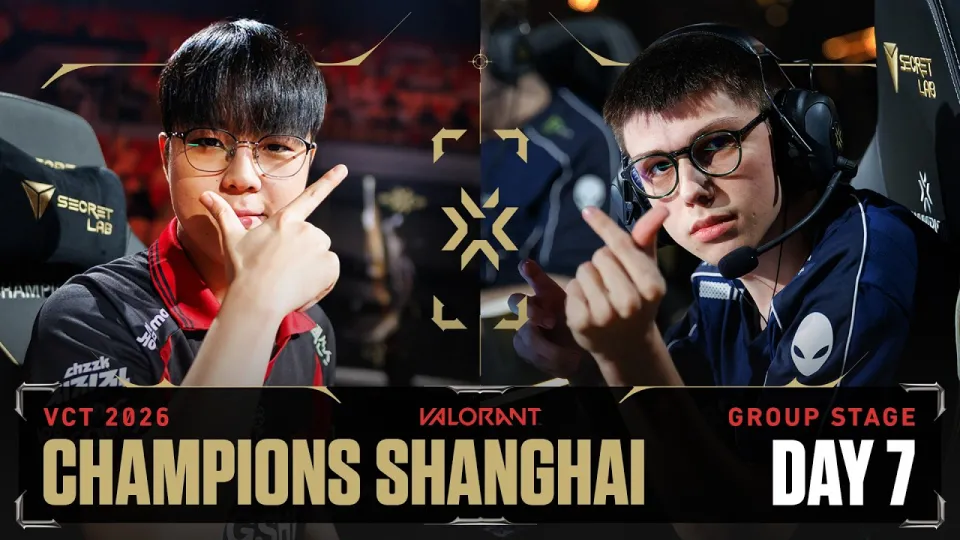
Video: VALORANT Champions Shanghai — Group Stage — Day 7
Want articles like this for your own video to promote it on YouTube and Google? Order them through the Telegram bot @sat_sit_bot. The bot writes and publishes the articles itself (with your YouTube video embedded) on popular topical websites (no ads). Your first 50 articles are free.
VALORANT Champions Shanghai is the 2026 world championship of the VALORANT Champions Tour, a 16-team tournament running from September 24 to October 18 in which squads from the Americas, CN, EMEA, and Pacific fight for the biggest trophy of the year. The group stage is the opening phase that cuts the field down before the playoff bracket, and Day 7 is the seventh broadcast day of that phase, published by the VALORANT Champions Tour. For schedules, brackets, and official announcements, the tournament's news feed is the fastest source: official VALORANT Esports updates on X.
What the VALORANT Champions Shanghai format actually is
The format is a two-stage event: a group stage that seeds and eliminates teams, followed by a single-elimination playoff bracket. Sixteen qualified rosters are split into groups, and each group plays a round robin of best-of-three series. The top teams in each group advance; the rest go home. The playoff stage switches to best-of-five, which changes how teams draft maps and how much value a single comfort pick carries.
Because the group stage is best-of-three, map vetoes matter more than in the playoffs. A team that can only win on two maps is vulnerable in a Bo3 but far safer in a Bo5, where deeper map pools are rewarded. That is why group-stage upsets are common and why analysts watch veto sequences as closely as the scoreline.
Who competes at VALORANT Champions Shanghai
The field is built from four regional pipelines: Americas, CN (China), EMEA, and Pacific. Each region sends its strongest representatives based on the season's international results and regional circuit, which is why the group stage mixes familiar championship names with first-time contenders.
The 2026 season context matters here. Two different teams won Masters events during the year, which means the international pecking order was never settled. No roster arrived in Shanghai as an undisputed favorite, and the group stage became the first real test of whether the Masters winners could convert that form into a world title.
Reading Day 7 of the group stage
Day 7 is a full broadcast day, not a single match, so it carries several series back to back. That structure is what makes these streams useful beyond live viewing: you can watch how multiple regions approach the same map pool within a few hours.
The most common friction point in long broadcast days is the technical pause. Multiple pauses in one day are normal at international events, where player hardware, server stability, and broadcast infrastructure all have to line up, and they tend to cluster around map transitions and mid-round restarts. They disrupt viewing rhythm but rarely change competitive outcomes.
Common questions from the VALORANT community
Viewers regularly raise three concerns about this stage, and each has a concrete answer.
- Are technical pauses a sign of a broken event? Not usually. Pauses are the mechanism that protects competitive integrity, and tournament officials would rather stop a round than let a match continue on a compromised setup.
- Is CN really weaker than other regions? The argument that stronger teams missed the event from other regions is a recurring talking point, but the group stage is exactly where that claim gets tested. Regional depth is a season-long question, not something one broadcast day settles.
- Why do favorites lose to eco rounds and 5v2 retakes? Those losses usually trace back to utility usage under pressure. When a team's set strategies break down, improvisation quality decides rounds, and that gap shows up most visibly in low-buy situations and man-disadvantage retakes.
Where the group stage fits in the wider VCT season
The group stage is the filter, not the finish line. Its job is to identify which teams can survive a short series against unfamiliar opposition, and it produces the seeding that shapes the playoff bracket.
That makes Day 7 a useful checkpoint. By the seventh broadcast day, most groups have played enough series that patterns are visible: which teams rely on a single star player, which ones win through utility discipline, and which ones look lost once their prepared setups are countered. Those patterns are what playoff opponents scout.
Useful links
- Official VALORANT Esports news and announcements: https://x.com/valorantesports
- Facebook: https://www.facebook.com/ValorantEsports/
- Instagram: https://www.instagram.com/valorantesports/
- TikTok: https://www.tiktok.com/@valorantesports
- Twitch live channel: https://www.twitch.tv/valorant
Final takeaways on the Shanghai group stage
The group stage at VALORANT Champions Shanghai does one job well: it separates teams that can adapt inside a short series from teams that only win when their preparation lands perfectly. Technical pauses and regional arguments dominate the chat, but the competitive signal is in veto choices, utility usage on low buys, and how quickly a roster abandons a broken setup. The 2026 season's two different Masters champions make the bracket genuinely open, and the group stage is where that openness first becomes measurable. This breakdown follows the official broadcast from the VALORANT Champions Tour, which is the channel to watch for the remaining group-stage days and the playoff run. For schedules and results as they land, follow the official VALORANT Esports account on X.
Key takeaways
- VALORANT Champions Shanghai runs September 24 to October 18 and crowns the 2026 World Champion.
- Sixteen teams from Americas, CN, EMEA, and Pacific compete for the year's biggest trophy.
- Day 7 of the group stage is the seventh broadcast day of the opening phase, streamed by the VALORANT Champions Tour.
- Two different Masters champions in 2026 mean no single team arrives in Shanghai as the clear favorite.
- Group stage matches are best-of-three; the playoff bracket moves to best-of-five.
Source: VALORANT Champions Shanghai — Group Stage — Day 7 · Markdown version
Questions & answers
How many teams play at VALORANT Champions Shanghai?
Sixteen teams qualify from four regions: Americas, CN, EMEA, and Pacific. They are divided into groups for a round-robin group stage, and the survivors move into a single-elimination playoff bracket. The event runs from September 24 to October 18 and decides the 2026 world champion.
Why are there so many technical pauses during the broadcast?
International events combine player hardware, server conditions, and a large broadcast production, so pauses happen when any of those needs attention. Officials stop play rather than let a round continue on a compromised setup. Pauses are disruptive for viewers but exist to protect competitive integrity.
Are group stage matches best-of-three or best-of-five?
The group stage uses best-of-three series, while the playoff bracket moves to best-of-five. That shift rewards deeper map pools, because a team that can only win on two maps is far more exposed in a Bo3 than in a Bo5.
Does the group stage predict who wins the title?
Only partly. The group stage shows which teams adapt well inside short series and which depend on prepared strategies, and that is valuable scouting information for playoff opponents. But with two different Masters champions in the 2026 season, the bracket stays open and group-stage form does not guarantee a deep playoff run.